Why “best” almost never survives a real shift
Search for the top-rated insert and you will find a hundred contenders, each crowned best by someone. The trouble is that most rankings reward how a product feels in the first ten minutes, not how it performs at hour nine on a tile floor. A slab that feels plush at the counter can pack flat inside a month, and a stiff plastic shell can prop the arch without ever moving with the foot through a stride. The honest measure of a clinical insert is biomechanical: does it change how load travels through the foot, shift after shift. That is the standard Colony Ortho RX was designed to meet.
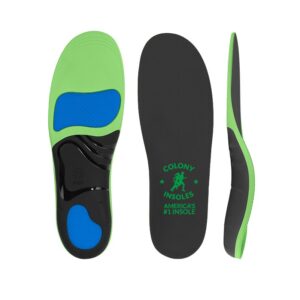 Doctor-Designed Orthotic
Premium Colony Ortho RX
- Recommended by podiatrists
- Memory foam + gel with real arch support
- 60-day money-back guarantee
- Free shipping within the USA
Three mechanical demands a serious orthotic must satisfy
A device worth the title has to do three things together rather than one in isolation. It must disperse impact force so peak loads do not keep hammering the joints above the ankle. It must govern arch motion, keeping the medial column from rolling inward as the foot moves through midstance. And it must resist deformation, holding its corrective geometry well past the new-shoe sensation. Most products on the shelf manage one of the three and quietly surrender the rest, which is exactly why the search never seems to end.
The case for a single engineered design
Rather than a wall of options, we produce one medical-grade orthotic built to cover all three functions at once, so you are not assembling a solution from partial products. The memory foam molds to your specific contours for support tuned to your foot. The gel layer absorbs peak force at each contact. The structured arch maintains alignment, helps check pronation, and resists packing down. It is podiatrist-engineered and priced plainly at $29 a pair. One device that addresses the full mechanical picture outperforms a drawer of inserts that each solve a fragment.
- Memory foam paired with gel, uniting molded support and force dispersion
- A structured arch design that helps govern pronation and keeps its form
- Built to support standing, walking, and running with reduced strain
- A single clinical specification instead of guessing across look-alike products
- Doctor-engineered orthotic support for people finished with experimenting
Whether it fits your situation
If the trial-and-error has worn thin, this is the shortcut past it. Whether you stand a full shift, log road miles, or simply want footwear that finally works with your gait, the orthotic suits the demand. Curious about the cushioning layers? Our heel inserts guide details targeted rearfoot support, and our arch support page explains how the medial column is held.
This is educational material, not individual medical advice. That is precisely why every pair carries a 60-day money-back guarantee and FREE shipping inside the USA. Run them through your own shoes, on your most punishing days. Get your Colony Ortho RX and close out the search.
Related Insoles & Guides
- Comfort Shoe Inserts for All-Day Relief
- Walking Insoles for All-Day Comfort
- Women's Insoles for All-Day Comfort
- High Arch Insoles for All-Day Comfort
- Comfort Insoles for All-Day Relief
- Men's Insoles for All-Day Support
Frequently Asked Questions
What separates a genuinely good insert from one that just reviews well?
Most rankings reward the first ten minutes of plushness, not hour nine on a tile floor. The clinical measure is biomechanical: does the device change how load travels through the foot, shift after shift. That requires dispersing impact, governing arch motion through midstance, and holding corrective geometry long after the new-shoe feel fades — three demands met together, not one in isolation.
How can I tell whether an insole will still be supporting me a few months in?
Resistance to deformation is the test. A slab that feels luxurious at the counter can pack flat within a month, at which point it manages neither impact nor alignment. Look for a structured shell beneath the cushioning — a layer whose job is to keep its corrective shape under repeated load — rather than foam alone, however thick that foam is.
Does a stiffer arch piece automatically mean better support?
No. A rigid plastic shell can prop the arch up while never moving with the foot through a stride, which trades one problem for another. Effective support governs motion — it limits the inward roll of the medial column at midstance without locking the foot — and pairs that control with shock dispersion so peak forces stop hammering the joints above the ankle.
Why does Colony Ortho RX sell one insole instead of a wall of options?
Because the three mechanical demands — impact dispersion, arch control, and shape retention — don’t change from buyer to buyer the way colors and marketing tiers do. We concentrated the engineering into a single $29 design that meets all three, sized to your shoe and trimmable for fit, rather than splitting effort across a catalog where each model quietly surrenders one demand.