The Arch That Won’t Hold Its Line
Watch a foot from behind during gait and overpronation announces itself: at heel strike the calcaneus tips inward, the talus drops medially, and the longitudinal arch lowers further than it should before the leg can push off. A degree of pronation is normal and even necessary for absorbing ground reaction force. The trouble begins when the motion runs past its end range and the foot fails to re-stiffen into a rigid lever for toe-off. That unchecked eversion drags the tibia into internal rotation, and the chain above pays the cost.
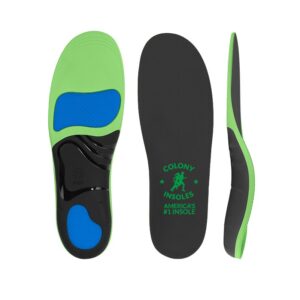 Doctor-Designed Orthotic
Premium Colony Ortho RX
- Recommended by podiatrists
- Memory foam + gel with real arch support
- 60-day money-back guarantee
- Free shipping within the USA
Where the Compensation Lands
Because the foot governs how rotation is transmitted up the leg, a rearfoot that everts too far forces the knee, hip, and pelvis to absorb torque they were not built to manage repeatedly. The posterior tibial tendon, the primary dynamic support of the medial arch, takes on a heavier eccentric load and can grow irritated over time. Tension along the plantar fascia climbs as the arch elongates under body weight. None of this is dramatic on any single stride, but multiply it across thousands of steps a day and a quiet mechanical fault becomes a real limit on activity.
Guiding the Rearfoot Toward Neutral
Colony Ortho RX is engineered to intercept that excess motion at its source. A rigid, geometrically contoured arch support cradles the medial column and resists the downward, inward drift that defines the pattern, holding the subtalar joint nearer its neutral axis. Layered over that shell, a memory foam and gel composite dampens impact at each landing so the structures above the ankle aren’t loaded by raw shock. This is a podiatrist-designed device built specifically for feet that roll past their limit.
- A semi-rigid arch shell that opposes medial collapse and restores a more neutral subtalar position
- Gel-based shock attenuation that buffers the knee, shin, and ankle from repetitive ground reaction force
- Conforming memory foam that supports the plantar surface through an entire shift
- Reduced strain on the posterior tibial tendon and plantar fascia as arch elongation is controlled
- A trim profile that seats inside athletic, occupational, and casual footwear for $29
Is This Your Pattern?
If a clinician has flagged your gait, if the inner soles of your shoes erode first, or if your arches feel like they sag as the day wears on, this device targets exactly that mechanics. Distance runners, floor nurses, educators, and anyone vertical for hours tend to feel the change soonest. Since overpronation rarely acts in isolation, addressing it early can help when you’re also contending with shin splints or recurring knee pain stemming from the same rotational fault.
Experience guided rearfoot control without committing up front. Colony Ortho RX ships with free U.S. delivery and a 60-day money-back guarantee. If your stride doesn’t feel more stable on your feet, return them. This is general education rather than personal medical advice. Realign your gait toward neutral.
Related Insoles & Guides
- Best Shoe Inserts for All-Day Comfort
- Heel Inserts for Heel Pain Relief
- Gel Insoles for Real Shock Absorption
- Height-Boosting Shoe Inserts
- Orthopedic Shoe Inserts
- Arch Support Shoe Inserts
Frequently Asked Questions
How can I tell whether I actually overpronate?
Watched from behind during gait, overpronation shows as the heel bone tipping inward after heel strike while the arch sinks lower than it should before push-off. Downstream clues include arches that ache as they elongate, irritation along the inner ankle where the posterior tibial tendon works, and knees or hips that complain after mileage. A podiatrist or gait analysis can confirm it.
Is pronation always a problem, or only past a certain point?
Pronation itself is functional; it is how the foot absorbs ground reaction force after heel strike. Trouble starts when the motion runs past its useful range and the foot never re-stiffens into the rigid lever push-off requires. At that point the rearfoot’s excess eversion drags the tibia into internal rotation, transmitting torque the knee, hip, and pelvis were not built to manage repeatedly.
Where in the gait cycle does this orthotic actually intervene?
It intercepts the fault at its source, between heel strike and midstance. The rigid, geometric arch support meets the medial arch as it begins to lower, resisting the excess eversion before it can drag the tibia into rotation. That also spares the posterior tibial tendon part of its eccentric workload and limits how far the plantar fascia elongates under body weight.
Will guiding my rearfoot toward neutral feel strange at first?
Often, yes. If your rearfoot has everted freely for years, holding it nearer neutral redirects load through tissues that are not used to it, and the arch contact can feel assertive during the first days of wear. Build up wear time gradually rather than forcing full shifts immediately. Pressure that stays painful rather than merely unfamiliar is worth a fit check or a clinician’s opinion.