The wear pattern that names your gait
Supination, the clinical term many know as underpronation, slips past a lot of runners and walkers until something starts to ache. In this pattern the foot fails to roll inward enough during stance and stays tipped toward its outer edge, so contact concentrates along the lateral column. Flip a well-worn shoe and the story is printed on the outsole: the tread thins first at the outer heel and the pinky-toe side. Pair that with shins and knees that feel beaten up after a long outing, and lateral overload is usually the culprit working silently in the background.
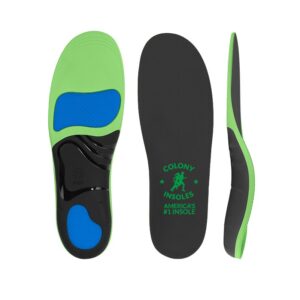 Doctor-Designed Orthotic
Premium Colony Ortho RX
- Recommended by podiatrists
- Memory foam + gel with real arch support
- 60-day money-back guarantee
- Free shipping within the USA
Why a rigid, high-arched foot punishes the leg
A correctly functioning foot pronates a small amount on landing to unlock the joints of the midfoot and let the arch flatten as a built-in damper. A supinating foot is typically high and stiff, so it never reaches that flattened, shock-absorbing position. With the foot’s own suspension switched off, ground reaction force passes upward through the lateral ankle, shin, and knee largely undiminished. That is why underpronators turn ankles more easily and accumulate fatigue along the outside of the leg. Reshaping the landing is structural protection for everything stacked above the foot.
How this insole supports a supinating foot
This orthotic rebuilds the cushioning and guidance a rigid foot cannot supply for itself. A gel stratum reinstates the shock attenuation that supination removes, while plush memory foam relieves the overworked lateral border. The geometric arch nudges the foot toward a more neutral, balanced contact instead of letting it tip outward through stance. It is the supportive, medical-grade approach our podiatrist-informed design is built around, and it can take real strain out of walking and running.
- Gel cushioning that restores attenuation a stiff arch lacks
- Memory foam that offloads the overloaded outer foot
- Geometric arch support guiding the foot toward neutral contact
- Less force routed up the lateral ankle, shin, and knee
- More balanced loading from initial contact through toe-off
Sound familiar?
Tall rigid arches, outsoles worn along the outer edge, and outer-leg soreness after exercise all point toward supination. Because the two traits travel together, many readers also benefit from our page on high arch support, and for daily relief our comfort insoles overview complements this one well.
Your own gait should not erode your legs one stride at a time. For $29 a pair, with free USA shipping and a 60-day money-back guarantee, you can reshape how your foot lands and judge the result yourself. Order a pair and balance your loading.
Related Insoles & Guides
- Insoles for Supination (Underpronation)
- Best Insoles for Nike Shoes
- Orthopedic Insoles
- Powerstep Alternative
- Superfeet Insole Alternative
- Xstance Insole Alternative
Frequently Asked Questions
What does the wear on my shoe soles reveal about underpronation?
Flip over a well-worn pair. If the tread is thinnest at the outer heel and along the pinky-toe side, contact is concentrating on the lateral column and your foot is likely staying tipped outward through stance. Shins and knees that feel beaten up after long outings, and ankles that roll easily, are common companions to that wear pattern.
Why does a supinated landing feel so hard on the outside of my legs?
A foot is supposed to pronate slightly on landing: that small inward roll unlocks the midfoot joints and lets the arch flatten as a built-in damper. A high, rigid, supinating foot never reaches that shock-absorbing position, so ground reaction force passes up the lateral ankle, shin, and knee largely undiminished — which is why fatigue and soreness accumulate along the outside of the leg.
Won't arch support push a high-arched foot even further onto its outer edge?
It’s a fair concern, but support works differently here than it does for flat feet. The goal is to fill the space under a high arch so load spreads across the whole plantar surface instead of concentrating on the outer edge. Contact, not lift, is what moves pressure off the lateral column and gives a stiff foot somewhere to share the work.
Can a stabilizing insole help ankles that roll easily?
Underpronators turn ankles more easily because weight rides the outer border of the foot, leaving little margin when a surface shifts. Centering load and stabilizing the rearfoot improves the platform you balance on. That is structural support, not a guarantee against sprains — recurrent instability or a previously injured ankle deserves evaluation by a clinician.