Great Shoe, Missing Backbone
Skechers practically reach for themselves: slip-on ease, a pillowy first impression, a match for nearly any outfit. Still, the same gripe keeps resurfacing. Hand that plush foam a few weeks and it compacts, leaving the arch with nothing bracing it through a long stretch on your feet. The goal here isn’t swapping out a shoe you favor; it’s installing the structural backbone it shipped without.
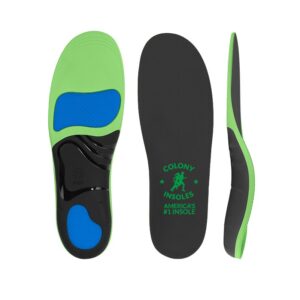 Doctor-Designed Orthotic
Premium Colony Ortho RX
- Recommended by podiatrists
- Memory foam + gel with real arch support
- 60-day money-back guarantee
- Free shipping within the USA
Why Plush-Only Foam Gives Out
Soft foam feels glorious for an opening hour. Its ceiling is mechanical: padding carrying no internal frame compresses under bodyweight and lends zero scaffolding beneath the medial column. Left unanchored, the foot keeps rolling inward at every step, and that unchecked inward roll is what delivers you to mid-afternoon nursing a spent arch, tender heels, and a flattened, worn-out feeling, even inside a shoe everyone praises as easy on the feet.
What This Footbed Installs in Your Skechers
This footbed lends the shoe a genuine spine. A structured geometric arch support seats the foot in a steady, neutral posture and helps curb excess inward roll, while memory foam riding a gel base serves cushioning that springs back rather than packing flat. You retain the plushness that sold you, now perched on real shock attenuation. Lift the stock liner out, seat ours in its slot, and a cozy shoe goes biomechanically supportive within moments. Errand-runners logging long days call it the thriftiest upgrade they have ever made to shoes already sitting in the closet.
- Supplies the firm arch bracing soft factory foam simply can’t
- Foam and gel tuned to shrug off compression week upon week
- Helps rein in inward roll, easing tired arches and tender heels
- Genuine shock attenuation that makes marathon errand days bearable
- Engineered to the standard podiatrists recommend
Who This Fits
Daily Skechers fans, walkers, and anyone wanting their everyday casual shoe to brace the foot from morning coffee to the final stop. If you swap shoes for workouts or bigger mileage, see our guidance for running, our page on easing ball of foot pain when forefoot pressure mounts, or our take on heel pain relief. Read this as general foot-health education, never personal care.
Keep the shoes you reach for and lend them the backbone they lacked. Priced at $29, this medical-grade footbed shaped by podiatrists ships with delivery covered nationwide behind a 60-day return promise. Outfit your Skechers with Colony Ortho RX.
Related Insoles & Guides
- High Arch Support Insoles for Pain Relief
- Cycling Shoe Insoles & Arch Support
- Insoles for Pregnancy: Arch & Foot Support
- Insoles for Flat Feet & Arch Support
- Arch Support Shoe Inserts
- Arch Support Shoe Inserts
Frequently Asked Questions
Why did my Skechers feel great at first and flat a month later?
Soft foam without an internal frame compresses under bodyweight. The plush layer that made the first weeks feel pillowy compacts with wear, and once it does, nothing braces the medial column. Each step then rolls inward unchecked, which is why a shoe that felt easy ends afternoons with a spent arch and tender heels.
Do I keep the original Skechers footbed in or take it out?
Take it out. Lift the stock liner from the shoe, trim this footbed to match its outline, and drop it in its place. Replacing rather than stacking keeps the fit of the shoe unchanged while swapping a compacted, frameless foam layer for one with a structured arch shell underneath.
Will adding structure make my Skechers lose the soft feel I bought them for?
No — the plushness stays; it gains a foundation. Memory foam still meets your foot first, riding on a gel base that springs back instead of packing flat. The difference is what sits beneath: a geometric arch support that holds the foot in a steady, neutral posture so the softness no longer collapses into instability.
How does the arch shell stop my foot rolling inward all day?
It gives the medial column scaffolding that foam alone cannot provide. By seating the foot in a neutral posture and supporting the arch through stance, the shell curbs the excess inward roll that otherwise repeats with every step — the unchecked motion that leaves arches spent and heels tender by mid-afternoon.