When you live with arthritis, even a short walk becomes a calculation. The joints through your feet, knees, and hips tighten and object the instant they bear weight, and every firm step arrives like a small jolt. By nightfall those repeated jolts have pooled into deep, wearing pain. If you have quietly given up the stairs, the errands, or the loop around the neighborhood, you are in good company, and it does not have to stay that way.
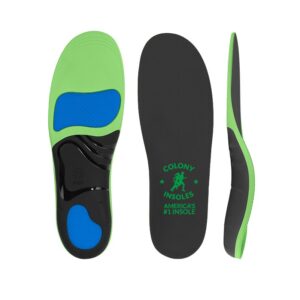 Doctor-Designed Orthotic
Premium Colony Ortho RX
- Recommended by podiatrists
- Memory foam + gel with real arch support
- 60-day money-back guarantee
- Free shipping within the USA
Why a Firm Step Lands So Hard
Arthritis erodes the cartilage that pads your joint surfaces, so bone tracks closer to bone and inflammation ignites. With that built-in shock absorber thinned, the impact of striding across pavement and hard flooring drives straight into joints that are already irritated. The principle is plain: whatever force your feet fail to dissipate, your knees and hips are conscripted to absorb instead.
Softening the Moment of Contact
This is exactly where an orthotic earns its place. We stacked pliable memory foam over a supportive gel base to form a barrier that intercepts impact before it can reach a sore joint. The geometric arch cups the foot and spreads load more evenly, relieving the concentrated pressure points arthritis tends to seek out. Rather than each step rattling you, you get padded, governed landings that help keep you upright and moving.
An Honest Note, and Who Benefits
Let me be straightforward: no insole reverses arthritis, and this is broad education, not advice for your specific case. Still, cushioning every footfall is a practical, honest way to make a day gentler on your joints. This is for anyone whose arthritis makes time on their feet harder than it ought to be, the older adults, the active retirees, the folks managing joint pain who fully intend to keep walking the dog and working the garden.
- Memory foam over gel that dampens shock before it reaches inflamed joints
- A geometric arch that redistributes body weight and relieves pressure points
- A stable platform that backs confident, comfortable movement
- A podiatrist-designed, medical-grade build trusted for all-day use
- A slim, adaptable fit for sneakers, walking shoes, and everyday footwear
Change what happens underfoot and the rest of the body often follows. If standing is the toughest part of your day, read insoles for standing all day, or browse our shoe inserts for knee pain for support that cooperates with your joints. Many readers also explore relief for plantar fasciitis when the heel flares.
Put them to the test with free USA shipping and a 60-day money-back guarantee. If they do not help, send them back, no fuss. One premium orthotic, one fair price of $29 a pair. Your joints have carried you a long way, so give them the cushioning they have earned.
Related Insoles & Guides
Frequently Asked Questions
What does an insole change for joints that have lost cartilage?
It cannot rebuild cartilage, and we will not pretend otherwise. What it changes is the force profile each step delivers: memory foam over a gel base intercepts part of the impact before it reaches an irritated joint, and the geometric arch spreads load across the whole footprint instead of letting it spike at the pressure points arthritis seeks out.
Can a footbed help arthritic knees and hips, or only the feet?
The mechanics connect them. Force your feet fail to dissipate transmits upward, so knees and hips absorb whatever the first contact point passes along. Attenuating impact at the heel and governing how the foot lands lowers the jolt those joints receive each step. It is load management for the whole chain, beginning at the ground.
Is a soft, mushy insole the right call for arthritic feet?
Softness alone is not the goal; a footbed that bottoms out just relocates pressure. Arthritic joints generally do better with cushioning governed by structure: pliable foam to soften contact, a gel base so it does not collapse, and an arch that cups the foot to keep load distributed. Padding plus control, not padding alone.
When should I wear these, and do they replace my arthritis treatment?
Wear them whenever you are weight-bearing — errands, stairs, the neighborhood loop you may have been avoiding — since every unsupported step adds to the day’s cumulative jolt count. They are a mechanical aid, not a substitute for whatever your physician or rheumatologist has prescribed. Think of them as one layer of load management within a broader plan.