What Supination (Underpronation) Is
Supination, also called underpronation, describes a foot that rolls outward and fails to flatten enough during the gait cycle. In a balanced stride, the foot rolls slightly inward after heel strike so the arch can lower and absorb impact. When you underpronate, that inward motion is limited, and weight stays concentrated on the outer edge and the ball of the foot. This pattern is common in people with a rigid, high-arched foot type, where the arch acts more like a stiff lever than a shock absorber. The result is reduced natural cushioning, repetitive outer-foot loading, and added strain that can travel up through the ankles, shins, and knees. It is essentially the biomechanical opposite of overpronation, and it tends to be more structural and less correctable than a flexible flat foot.
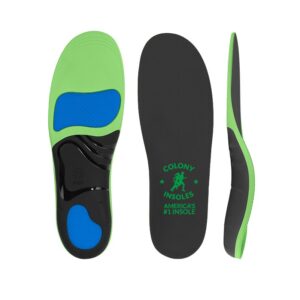 Doctor-Designed Orthotic
Premium Colony Ortho RX
- Recommended by podiatrists
- Memory foam + gel with real arch support
- 60-day money-back guarantee
- Free shipping within the USA
How Orthotic Support Helps Biomechanically
Because the underpronating foot does not absorb shock well on its own, the goal of an orthotic insole is to add cushioning while gently guiding the foot toward a more neutral, even contact pattern. Rather than forcing the arch to move, a doctor-designed insole supports it and compensates for the shock absorption a stiff foot lacks. It does several things at once.
- Contoured arch support fills the gap under a high arch so load spreads across more surface area instead of the outer border alone.
- A structured heel cup helps center heel strike and limit excessive outward roll at the moment of contact.
- Shock-absorbing materials reduce the repetitive impact a rigid foot otherwise transmits up the leg with every step.
- Even pressure distribution can ease secondary stress that contributes to plantar fasciitis and heel pain along the bottom of the foot.
- Improved alignment helps the ankle and knee track through each step rather than working against an off-balance load.
Who Supination Orthotics Suit
Supportive orthotics suit people who notice outer-edge shoe wear, tight calves, recurring ankle rolls, or shin and outer-knee soreness after activity. They are especially useful for high-arch runners, walkers, and anyone on their feet for long stretches, such as those who need reliable support for standing all day. Because supination so often pairs with a stiff, less forgiving foot, cushioning matters just as much as structure, and a one-size catalog of thin inserts rarely delivers both.
Choosing Colony Ortho RX
Our podiatrist-designed insole combines firm biomechanical support with a cushioned top layer, giving the rigid, underpronating foot both stability and shock relief in a single $29 insole. It is one trusted design instead of a confusing catalog of options, sized to fit common footwear and built for everyday wear. If you have measured your foot type against alternatives, you can also compare it directly in our Colony Ortho RX vs Superfeet breakdown. Shop Colony Ortho RX — $29
Related Orthotics & Guides
- Orthotic insoles overview
- Arch support shoe inserts
- Insoles for high arches
- Overpronation orthotics (the opposite pattern)
- Colony Ortho RX vs Superfeet
Frequently Asked Questions
Can orthotics fix supination?
Orthotics do not permanently change your foot structure, but they manage supination effectively by adding shock absorption and guiding the foot toward more neutral, even contact. This reduces outer-edge overload and the strain it places on the ankles, shins, and knees during walking and running.
Do I need arch support or cushioning for underpronation?
Both. A supinating foot is usually high-arched and rigid, so it needs contoured arch support to spread load across more surface area, plus cushioning to make up for the shock absorption a stiff foot lacks. Colony Ortho RX combines firm support with a cushioned top layer to address both at once.
How do I know if I supinate?
Common signs include shoe wear concentrated on the outer edge, frequent ankle rolls, tight calves, and outer-knee or shin soreness after activity. A high, rigid arch also points toward underpronation. For a definitive assessment, a podiatrist can evaluate your gait directly.
Are supination orthotics different from overpronation orthotics?
The biomechanical goals differ. Overpronation control emphasizes limiting inward collapse, while supination support emphasizes cushioning and filling a high arch to encourage fuller, more even foot contact. The same well-designed insole can serve many foot types because it restores more neutral mechanics.