The heavy-legged fatigue that sets in by midday
A common complaint is that the feet feel dead halfway through the day. That flat, dragging fatigue usually traces back to a footbed with no rebound, one that either wore out or never offered any to begin with. A device with no return simply compresses and stays compressed. It softens the first few steps and then stops contributing, and from that point the legs power every stride on their own, which accelerates fatigue through the foot and lower limb.
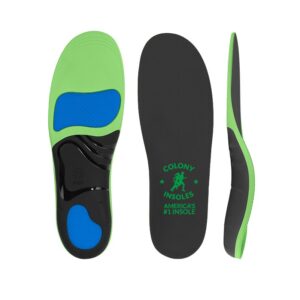 Doctor-Designed Orthotic
Premium Colony Ortho RX
- Recommended by podiatrists
- Memory foam + gel with real arch support
- 60-day money-back guarantee
- Free shipping within the USA
What energy return contributes to gait
Effective support has two mechanical jobs, not one. It must attenuate the impact when the foot lands, and it should return a portion of that energy during push-off. That second function is the responsive component cheaper inserts omit. Without it, each stride demands a little more effort, the foot tires faster, and walking becomes a grind. With it, the foot progresses cleanly through the heel-to-toe sequence and you reach the end of the day with more in reserve. This is not marketing, it reflects how an efficient gait cycle is meant to load and unload.
How this orthotic restores rebound underfoot
We pair a conforming memory foam layer with responsive gel that compresses on landing and recovers during push-off, so you get the cushioned catch and the responsive return within the same step. Beneath that sits a structured, geometric arch that keeps the medial longitudinal arch from collapsing and dissipating energy, directing the stride efficiently. It is podiatrist-designed support tuned to keep you moving, standing, walking, and running, while reducing the foot and leg fatigue that builds through a long day.
- Responsive gel that recovers and returns energy through push-off
- Conforming foam that attenuates the landing before impact reaches the joints
- Structured arch mechanics that limit arch collapse and channel each stride
- Genuine shock attenuation to delay foot and lower-limb fatigue
- Podiatrist-designed construction engineered for efficient gait loading
Who feels the difference most
Walkers, runners, and warehouse and retail staff whose feet fatigue long before their shift ends tend to notice the rebound first. If you are upright for hours, you will feel how energy return eases the cumulative load. If your foot rolls laterally, see how we address supination correction at the same time. And if you are weighing options, here is how this device compares with the major insole brands. This is educational information, not a diagnosis or personal medical advice. Explore Colony Ortho RX orthotic insoles and put efficient rebound back into your stride.
Related Insoles & Guides
- Best Insoles for Nike Shoes
- Orthopedic Insoles
- Powerstep Alternative
- Superfeet Insole Alternative
- Xstance Insole Alternative
- Height Increase Insoles
Frequently Asked Questions
What does energy return actually mean in an insole?
Support has two mechanical jobs: absorbing impact when the foot lands, and giving a portion of that energy back as you push off. Energy return is that second function. A responsive material compresses on landing and recovers its shape during toe-off, contributing to the stride instead of merely deadening it. Inserts without rebound simply compress, stay compressed, and leave your legs doing all the work.
Why do my legs feel dead by midday even in cushioned shoes?
Cushioning that only absorbs is a one-way transaction. A footbed with no rebound softens your first steps, then sits compressed and contributes nothing, so from that point your muscles supply every bit of forward progress unaided. Multiplied across thousands of strides, that small extra effort per step accumulates into the flat, dragging heaviness people describe by midday.
Does Colony Ortho RX contain actual metal springs?
No — the spring is material behavior rather than hardware. A conforming memory foam layer pairs with responsive gel that compresses as the foot lands and recovers its shape during push-off, producing the cushioned catch and rebound the name describes. Mechanical coils are unnecessary for that loading-and-unloading cycle, and an all-material build sits flatter in a shoe than embedded hardware would.
Can energy return matter for someone who walks all day, or is it just for runners?
The mechanism applies to anyone cycling through repeated heel-to-toe loading — walking workdays included, not just running. Every stride contains a landing the insole softens and a push-off it can assist by releasing stored compression. Per step the contribution is small; its value compounds over thousands of repetitions, which is why the intended payoff is more left in reserve at day’s end.