The Forefoot Under Excess Load
Metatarsalgia describes pain and inflammation concentrated at the ball of the foot, beneath the metatarsal heads. Patients often describe it as a bruised, burning sensation, or the feeling of a pebble underfoot that never moves. The pattern is mechanical: the forefoot is absorbing more vertical load than its tissues are built to tolerate, repeated with every step. Colony Ortho RX approaches this the way a clinician would, by looking at where the load is going and redistributing it, rather than simply padding the area.
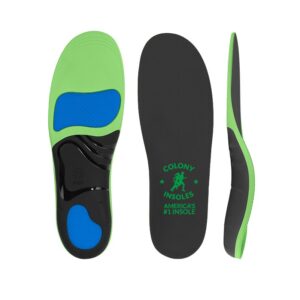 Doctor-Designed Orthotic
Premium Colony Ortho RX
- Recommended by podiatrists
- Memory foam + gel with real arch support
- 60-day money-back guarantee
- Free shipping within the USA
Why Pressure Concentrates There
The five metatarsal heads are designed to share forefoot load across a broad surface during the push-off phase of gait. When the medial arch drops or a shoe lacks structure, that transverse arch flattens and pressure migrates onto one or two heads, frequently the second and third. Tissue under that focal point becomes irritated and stays irritated. Thin, flat footbeds make it worse by adding ground reaction force to an already overloaded region. Cushioning by itself does not address the underlying distribution problem.
How the Orthotic Redistributes Load
This insole is built around a structured, geometric arch shell that helps restore the foot’s natural contour and support the transverse arch. By re-establishing that architecture, contact pressure spreads back across the full forefoot instead of concentrating on a single tender region. Layered memory foam and gel add targeted shock attenuation directly under the metatarsal heads, dampening the impact forces that drive forefoot irritation. It is the kind of pressure-redistributing support podiatrists recommend, designed to drop into the footwear you already wear.
- Arch geometry that offloads pressure from the metatarsal heads
- Forefoot cushioning positioned where focal load concentrates
- Shock attenuation that reduces ground reaction force through thin soles
- A supportive base that helps an irritated forefoot settle and recover
- Improved load distribution to support standing and walking with less focal pain
Who This Supports
If you recognize that burning, marble-underfoot sensation, particularly after extended weight-bearing, this orthotic was engineered with your forefoot in mind. People working long shifts on hard surfaces tend to notice the change in pressure distribution quickly, as do those whose unsupportive footwear contributed to the problem. Comparing options for related forefoot complaints? Review our gel insoles or our dedicated forefoot pressure-relief inserts.
This is educational guidance on forefoot mechanics, not a diagnosis or a substitute for evaluation by your own clinician. Every order ships free within the USA under our 60-day money-back guarantee. Get your Colony Ortho RX for $29 and take the load off your forefoot.
Related Insoles & Guides
- Inserts for Metatarsalgia
- Best Insoles for Nike Shoes
- Orthopedic Insoles
- Powerstep Alternative
- Superfeet Insole Alternative
- Xstance Insole Alternative
Frequently Asked Questions
How can arch support relieve pain that sits at the ball of my foot?
Because the overload at the metatarsal heads usually starts farther back. When the medial arch drops, the transverse arch flattens with it, and forefoot pressure migrates onto one or two heads — frequently the second and third. By helping restore the foot’s natural contour, the structured arch shell encourages load to share across all five heads again instead of concentrating on the irritated spot.
Why hasn't extra padding under the forefoot fixed it?
Padding changes how the overload feels; it does not change where the load goes. If pressure keeps funneling onto the same one or two metatarsal heads at every push-off, the tissue beneath them stays irritated under the cushion. Redistribution — re-establishing arch contour so force spreads across the whole forefoot — addresses the mechanical cause rather than muffling the symptom.
What causes the pebble-underfoot sensation people describe?
It typically reflects focal overload: one metatarsal head bearing more vertical force than its surrounding tissue tolerates, so every step presses the same inflamed point — like a stone fixed in place. That description is common in metatarsalgia. Persistent or worsening forefoot symptoms still merit a clinical exam, since several distinct conditions can produce similar sensations.
Do thin, flat footbeds actually make forefoot pain worse?
They can compound it. A thin, level footbed offers no arch engagement, so the transverse arch stays flattened and pressure stays concentrated on the overloaded heads — while minimal cushioning lets more ground reaction force reach tissue that is already irritated. A contoured, supportive footbed changes both variables at once: where the load goes and how much impact arrives with it.