That Searing Stripe Along the Front of the Leg
If you have lived through shin splints, the feeling needs no introduction: a sharp, pulsing band running down the lower leg that lights up the second you quicken your tempo. It tends to strike two camps hardest, runners who ramped their volume too fast and people freshly stuck in a job that keeps them on their feet for hours. That ache, labeled in the clinic as medial tibial stress, is tissue waving a flag that the demand has outrun its capacity. Grinding through it usually deepens the problem.
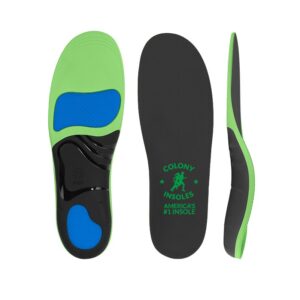 Doctor-Designed Orthotic
Premium Colony Ortho RX
- Recommended by podiatrists
- Memory foam + gel with real arch support
- 60-day money-back guarantee
- Free shipping within the USA
The Loop That Keeps It Coming Back
Shin splints almost always boil down to two levers, the way the foot travels and the volume of impact the lower leg must swallow. When the arch caves inward, the muscles threading down the shin fire overtime to steady the foot, and that relentless tension inflames them. Tired shoes and concrete pile on shock with every contact. Until both the support and the damping get handled at the level of the foot, the same stripe of pain reignites the next time you load the legs.
Quieting Both Levers at Once
We engineered the orthotic to confront both drivers together. The structured, geometric arch support resists the inward collapse, which dials down the overtime workload on the shin muscles. Underneath, the memory foam and gel attenuate shock at each contact so less of it travels up the tibia. Colony Ortho RX is podiatrist-designed, and for this condition that union of rearfoot control and shock attenuation is precisely what the lower leg is asking for.
- Firm arch geometry that relieves overtaxed shin muscles
- Gel attenuation that takes the sting out of every footstrike
- Memory foam structure that endures long runs and long shifts
- Slots into running shoes and work shoes alike
- Clinically grounded support for $29 a pair
Who Needs These
If you are stacking miles, breaking in a job that keeps you upright, or fed up with that burn flaring every time you stride out, this is engineered for you. Shin splints seldom show up solo. Plenty of people managing them are simultaneously wrestling overpronation or lingering knee pain, and bracing the arch helps shield the whole kinetic chain. Sharp or escalating shin pain belongs in front of a clinician to rule out other causes.
Do not surrender another run to shin splints. Try Colony Ortho RX with free U.S. shipping and a 60-day money-back guarantee, so you can prove them out where it counts, on the road. Return to running without the burn.
Related Insoles & Guides
- Insoles for Shin Splints Relief
- Best Shoe Inserts for All-Day Comfort
- Heel Inserts for Heel Pain Relief
- Gel Insoles for Real Shock Absorption
- Height-Boosting Shoe Inserts
- Orthopedic Shoe Inserts
Frequently Asked Questions
Does this insole address what causes shin splints, or only cushion the impact?
Both levers matter, which is why the design tackles them together. The structured arch support resists the inward collapse that forces the muscles along your shin to fire overtime stabilizing the foot, while the memory foam and gel underneath absorb impact before the tibia has to. Cushioning alone quiets the symptom; controlling foot motion targets the overload driving it.
Why do my shin splints come back every time I return to running?
Because the underlying loop usually goes unaddressed. Medial tibial stress flares when demand outruns the lower leg’s capacity, and if your arch still caves inward on every stride, the shin musculature returns to the same overworked state as soon as you reload it. Rebuilding volume gradually while supporting the arch and damping impact changes the conditions, not just the timeline.
I'm on my feet all shift but don't run — is this still relevant?
Shin splints hit both camps: runners who ramp mileage too quickly and people newly spending full workdays standing. The mechanics are the same, repetitive impact plus an unstable arch. The insoles trim to fit work boots and everyday shoes alike, and prolonged standing on hard floors is exactly the loading pattern the gel and foam layers are built to blunt.
Should I keep training through the pain once the insoles arrive?
No. Grinding through medial tibial stress usually deepens it. Treat the insole as a way to lower the load on irritated tissue, not a license to ignore the flag it is raising. Cut volume until the sharp band along the shin settles, rebuild gradually, and have pain that persists or worsens evaluated by a sports medicine or podiatric clinician.