The Foot That Refuses to Stay Put
This complaint reaches us almost daily at Colony Ortho RX. The foot migrates toward the toe box, the heel pops loose with each push-off, and by afternoon you’re nursing a hot spot at the forefoot and a deep ache through the midfoot. A shoe that can’t pin the foot in place isn’t merely annoying. It corrupts the timing of your gait cycle and erodes comfort steadily across a long day. The remedy is mechanical, it lives inside the existing shoe, and it doesn’t require discarding a pair you otherwise like.
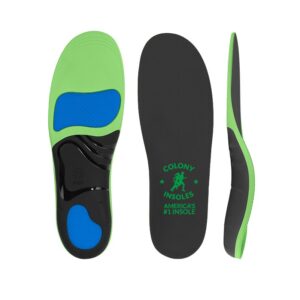 Doctor-Designed Orthotic
Premium Colony Ortho RX
- Recommended by podiatrists
- Memory foam + gel with real arch support
- 60-day money-back guarantee
- Free shipping within the USA
Why a Stable Footbed Reshapes Your Stride
Each time the foot translates, stabilizing musculature contracts simply to keep the limb balanced over its base. That continuous, unproductive effort drains the foot and disrupts a clean stance phase before you’ve consciously noticed. Repeated shear from the motion abrades skin into friction blisters and calluses, and an unexpected slide on a smooth floor leaves you wearier than the mileage justifies. Lock the foot into a supported, neutral position and the gait cycle runs as designed, efficient and reproducible, instead of bleeding energy into the work of staying upright.
How the Orthotic Locks You In
Our device grips so your muscles can stand down. The memory foam top layer molds to the plantar surface and resists forward shear, while the structured arch shell anchors the midfoot and curbs the drift that lifts the heel. A shock-attenuating gel base holds the entire foot stable and cushioned at the same time. It’s a medical-grade, podiatrist-designed build that converts a loose, sloppy shoe into one that finally secures the foot where it belongs.
- Contoured memory foam that opposes forward shear and translation
- A structured arch support that anchors the midfoot and limits heel slip
- Gel cushioning that dampens impact across every step
- A low-bulk profile that fits most occupational and everyday footwear
- FREE USA shipping on every order
Who Reaches for This
Waitstaff, nurses, warehouse teams, anyone logging hours on slick or polished floors notices the difference fast. If you also want a smarter, lower-cost option than the shelf brands, see why people pick us over Superfeet, or read how the right orthotic can help accommodate a leg length difference.
Put Colony Ortho RX to the test risk-free for 60 days. If your feet aren’t steadier and more comfortable, your money comes back. One clinically focused orthotic, $29 a pair, engineered to keep you anchored through your longest shifts. This is general education, not personal medical advice. Grab your pair and put an end to the sliding.
Related Insoles & Guides
- Stop Feet Sliding Forward in Shoes
- Shoe Inserts for Ball of Foot Pain
- Insoles for Ball of Foot Pain
- Insoles for Pregnancy: Arch & Foot Support
- Shoe Inserts for Foot Pain Relief
- Foot Conditions Glossary
Frequently Asked Questions
How does this insole stop my foot from sliding without any tacky or adhesive surface?
The grip is geometric, not adhesive. The memory foam top layer molds to your plantar surface, so the foot sits in a matched impression rather than on a flat plane, while the contoured heel area blocks forward and sideways translation. The foot stays put because the footbed fits it, letting stabilizing muscles stand down.
Why does my heel pop loose at push-off even when the shoe length is right?
Push-off lifts the rearfoot while the shoe lags behind it, and a flat, slick liner gives the heel nothing to register against. A contoured footbed — cupped at the heel, supported through the arch — keeps the foot indexed to the shoe through the gait cycle instead of separating at its fastest-moving phase.
Can stopping the slide do anything about the hot spot on my forefoot?
That is where it comes from. Each forward migration shears skin against the footbed and toe box, and repeated shear abrades skin into friction blisters and calluses. Anchor the foot in a supported, neutral position and the rubbing that builds the hot spot largely stops, giving irritated skin a chance to settle.
Does a foot that won't stay put really make me more tired by the end of a shift?
It can. Every slide forces stabilizing musculature to contract simply to keep the limb balanced over its base — continuous, unproductive effort that drains the foot beyond what your mileage justifies. Lock the foot into place and that background work switches off, so the stance phase runs as designed instead of bleeding energy.