What Metatarsalgia Is and Why It Hurts
Metatarsalgia is pain, aching, or burning under the ball of the foot, centered on the metatarsal heads just behind the toes. It often feels like walking on a pebble or bunched-up sock, and tends to worsen with standing, walking on hard surfaces, or wearing thin or high-heeled shoes. Common contributors include a high arch that loads the forefoot, a tight calf or Achilles, foot deformities like bunions or hammertoes, and high-impact activity. When pressure concentrates on a small area of the forefoot for long periods, the soft tissue and joints under the metatarsal heads become inflamed and tender.
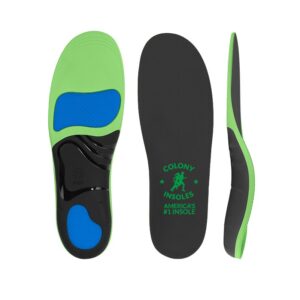 Doctor-Designed Orthotic
Premium Colony Ortho RX
- Recommended by podiatrists
- Memory foam + gel with real arch support
- 60-day money-back guarantee
- Free shipping within the USA
How Orthotic Support Helps Biomechanically
The goal of forefoot care is to redistribute pressure away from the painful metatarsal heads and improve how load travels through the foot during each step. A structured orthotic insole supports the arch so the foot does not collapse and overload the front of the foot, while cushioning helps absorb impact at push-off. Because forefoot pain frequently travels alongside arch and heel strain, the same support strategy used for plantar fasciitis and heel pain often eases ball-of-foot symptoms too.
- Arch support reduces forefoot loading by sharing weight across the midfoot instead of the metatarsal heads.
- Cushioning under the ball of the foot softens repetitive impact during standing and walking.
- Stabilizing the rearfoot limits the excess motion that can drive forefoot overload.
- Better alignment encourages a smoother, more even gait from heel strike to toe-off.
- Consistent daily wear in supportive shoes gives irritated tissue a calmer environment to settle.
Who Orthotics Suit
Forefoot-focused support tends to help people who stand or walk on hard floors all day, those with a high arch that pushes weight forward, and active people who feel ball-of-foot pain after exercise. If you also overpronate, pairing support with attention to overpronation can address a root contributor. Workers on their feet may benefit from insoles built for standing all day. This is general education, not personal medical advice; persistent, worsening, or numb forefoot pain should be evaluated by a podiatrist to rule out a stress fracture, neuroma, or other condition.
Related Orthotics & Guides
- Doctor-designed orthotic insoles
- Insoles for plantar fasciitis and heel pain
- Support for a high arch
- Insoles for overpronation
- Insoles for standing all day
Frequently Asked Questions
Can orthotics help metatarsalgia?
Orthotics can help by redistributing pressure away from the metatarsal heads and supporting the arch, which reduces forefoot overload. Structured insoles paired with supportive, well-fitting shoes give irritated tissue under the ball of the foot a better chance to settle, though results vary by cause and severity.
What kind of insole is best for ball-of-foot pain?
Look for an insole with firm arch support to share load across the midfoot, plus cushioning under the forefoot to absorb impact. A supportive orthotic that stabilizes the rearfoot helps control the excess motion that can concentrate pressure on the metatarsal heads.
Does a high arch cause metatarsalgia?
A high arch can contribute, because it tends to shift more body weight onto the heel and forefoot rather than the middle of the foot. That extra forefoot loading is a common driver of ball-of-foot pain, which is why arch support and forefoot cushioning are central to management.
When should I see a doctor for ball-of-foot pain?
See a podiatrist if pain is severe, persists for more than a few weeks, worsens, or comes with numbness, tingling, swelling, or pain that does not ease with rest. These signs can point to a stress fracture, Morton's neuroma, or another condition that needs professional evaluation.