Extra Height Should Not Cost You the Back Half of the Day
I am Jack Young, founder of Colony Ortho RX. Folks reach for lifts for all sorts of reasons, a touch more height, a steadier stance, a way to snug up the fit inside oversized footwear. The motive matters far less than a principle I have held from the start: a lift that aches is a lift you will abandon. Far too many are rigid plastic wedges that pass the in-store test and have the arches complaining by midday. Height and biomechanical support are not a trade-off.
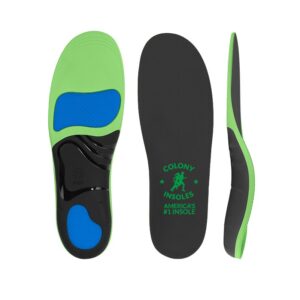 Doctor-Designed Orthotic
Premium Colony Ortho RX
- Recommended by podiatrists
- Memory foam + gel with real arch support
- 60-day money-back guarantee
- Free shipping within the USA
Why Elevating the Heel Rewrites the Load Beneath It
Raise the heel even a quarter inch and you reroute how pressure moves through the foot. Set that elevation on a thin, unyielding surface and the added height simply channels force onto the arch and the metatarsal heads. What felt fine briefly becomes a steady throb by closing time. A lift therefore carries two responsibilities at once: raise the heel, and cushion and support the foot while it sits elevated. Neglect the second and every minute upright will register, because no degree of height can offset an overloaded forefoot.
How We Construct a Lift Built for a Full Day
Ours is a cushioned, supportive lift made from layered memory foam and gel over structured, geometric arch support. Rather than a stiff wedge digging into the sole, you stand on a contoured platform that disperses impact and keeps the foot aligned while it rides a little higher. That union of elevation and genuine structural support is the entire point. It is the kind of podiatrist-developed support that lets you keep the boost and still stand, walk, and run without paying for it afterward.
- A cushioned lift that never sacrifices support for height
- Geometric arch support that holds the foot aligned
- Shock-dispersing gel underfoot with every step
- Helps tighten the fit in footwear that runs large
- One medical-grade pair at $29
Whether This Is for You
You want a comfortable boost, a closer fit in loose footwear, or simply something more supportive than the hard plastic lifts you have already tried and tossed aside. If sizing is truly the core of it, our inserts for shoes too big and our arch support insoles rest on the same supportive base. This is educational guidance, not a diagnosis.
A lift should feel as good as it looks and hold steady from morning through night. We ship free across the USA with a 60-day money-back guarantee, so wear them, and if they are not for you, send them back without hassle. Order your pair and step up with real support.
Related Insoles & Guides
- Comfortable, Durable EVA Foam Insoles
- Best Shoe Inserts for All-Day Comfort
- Heel Inserts for Heel Pain Relief
- Gel Insoles for Real Shock Absorption
- Height-Boosting Shoe Inserts
- Orthopedic Shoe Inserts
Frequently Asked Questions
Why do rigid plastic heel lifts start aching by midday?
A hard wedge passes the in-store test because brief standing hides the problem. Once you are upright for hours, the unyielding surface channels your elevated weight onto the arch and metatarsal heads with nothing absorbing it. The throb that builds by closing time is concentrated pressure, not the height itself, which is why a lift must cushion as well as raise.
Does raising the heel a quarter inch really change how the foot is loaded?
Yes. Elevating the heel reroutes pressure forward, shifting a larger share of every step onto the midfoot and the metatarsal heads. That redistribution is unavoidable physics, so the question becomes what catches the load. A lift built with arch support and forefoot cushioning lets the foot carry the new pattern; a bare wedge simply overloads it.
Can I use this lift to snug up shoes that run slightly large?
That is one of the most common reasons people buy it. The layered memory foam and gel take up excess interior volume so the heel stops sliding, while the geometric arch support keeps the foot aligned in its new position. You get a steadier stance and a closer fit without sizing down or stacking flat pads.
What keeps the forefoot comfortable while the heel sits elevated?
Two things working together: structured arch support that shares the rerouted load through the midfoot instead of letting it slide forward, and a memory foam and gel layer that absorbs pressure at the metatarsal heads. Because no amount of height offsets an overloaded forefoot, the lift is engineered to support the foot for a full elevated day.