The Miles Add Up, and So Does the Ground Reaction Force
I’m Jack Young, founder of Colony Ortho RX, and a runner myself, which is part of why this product exists. Running is one of the best things you can do for your body and one of the highest mechanical demands you can place on your feet. Each footstrike loads the foot with several times body weight, repeated thousands of times a run. With nothing structural underneath, that cumulative impact shows up as sore arches, tender heels, and legs that feel a decade older. I designed our orthotic to keep those miles biomechanically supported.
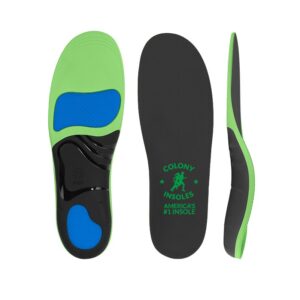 Doctor-Designed Orthotic
Premium Colony Ortho RX
- Recommended by podiatrists
- Memory foam + gel with real arch support
- 60-day money-back guarantee
- Free shipping within the USA
Why the Stock Sock Liner Gives Out First
Most running shoes ship with a thin, flat sliver of foam. A few weeks of pavement compress it flatter still, until it offers almost no arch support and even less shock attenuation than when new. From there the foot does nearly all the stabilizing and impact absorption on its own, stride after stride. That’s how overuse strain sets in, how localized hot spots form, and how the legs start fatiguing miles earlier than they used to. The shoe still looks fine outside, but the component that did the supporting wore out long ago.
How the Orthotic Holds Up Over Distance
Our insole brings memory foam and gel cushioning together with structured, geometric arch support so the foot stays stable and aligned through every footstrike. The gel shock attenuation reduces the impact reaching the joints, and the supportive contour helps delay the foot fatigue that drags your pace late in a run. It’s a podiatrist-developed design, whether you’re chasing a PR or finishing your first 5K upright.
- Cushioning engineered to hold its shape mile after mile
- Geometric arch support to stabilize your stride
- Gel shock attenuation that spares the joints
- Helps delay foot fatigue on long efforts
- One medical-grade pair for $29
Who This Is For
Daily runner, weekend jogger, or deep in a race build — these inserts help the foot go the distance. Runners tend to accumulate specific overuse complaints, so it’s worth reading our pages on shoe inserts for Achilles tendonitis and plantar fasciitis insoles. This is educational, not a diagnosis.
Don’t let a flattened factory liner cap your training. We ship free across the USA and stand behind every pair with a 60-day money-back guarantee — run on them, and if they don’t deliver, get your money back. Lace up with a fresh pair.
Related Insoles & Guides
- Running Insoles for Arch & Heel Relief
- Best Shoe Inserts for All-Day Comfort
- Heel Inserts for Heel Pain Relief
- Gel Insoles for Real Shock Absorption
- Height-Boosting Shoe Inserts
- Orthopedic Shoe Inserts
Frequently Asked Questions
How much force does running actually put through my feet?
Each footstrike loads the foot with several times your body weight, and a typical run repeats that impact thousands of times. The foot can manage that demand when the arch is supported and the heel is cushioned; with nothing structural underneath, the same mileage accumulates as sore arches, tender heels, and legs that fade early.
When should I assume my running shoe's stock liner has given out?
Sooner than the shoe’s exterior suggests. The factory liner is a thin slab of foam that pavement compresses within weeks, leaving almost no arch support and less shock attenuation than it had new. If your arches ache after runs that used to feel easy, the supporting component has likely worn out even though the midsole and upper still look fine.
Will a structured orthotic change how my legs feel late in a run?
Mechanically, yes. Late-run fatigue partly reflects how much stabilizing your feet do unassisted. When geometric arch support braces the midfoot and gel attenuates each impact, the muscles that absorb shock and slow pronation work less every stride. Spread across thousands of footstrikes, reducing that compensatory workload is how support shows up in the closing miles.
Do I run with this insole on top of the stock liner or in place of it?
In place of it. Pull the flat factory liner out, use it as a tracing guide, and trim the orthotic to match before sliding it in. Replacing rather than stacking preserves heel depth and toe-box room, keeps the foot seated correctly in the shoe, and puts the arch structure directly under your foot where it belongs.