Reading the wear pattern: what lateral loading tells you
Turn an old shoe over and study the sole. When the outer border grinds down while the medial side stays intact, your center of pressure is tracking along the lateral column of the foot through stance. Clinically this pattern is described as supination, or excessive lateral weight-bearing. The foot rolls toward its outer edge instead of progressing through a balanced heel-to-toe sequence, and the base of support narrows. Over time that lateral bias concentrates load on the fifth metatarsal, the peroneal structures, and the lateral ankle, and it can leave the outer foot, ankle, and knee feeling strained in a way that is hard to localize.
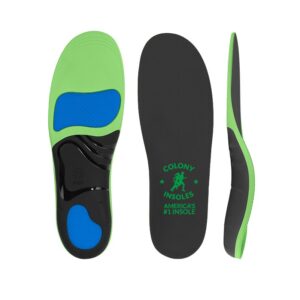 Doctor-Designed Orthotic
Premium Colony Ortho RX
- Recommended by podiatrists
- Memory foam + gel with real arch support
- 60-day money-back guarantee
- Free shipping within the USA
Why rearfoot alignment changes the load above
The foot is the foundation for the kinetic chain stacked above it. A supinated foot tends to sit in a more rigid, less mobile position, which blunts the arch’s role as a shock absorber. When the medial longitudinal arch cannot lower and recoil normally, ground reaction force travels up the leg less evenly and the same joints absorb repeated impact. Guiding the rearfoot back toward a more neutral, centered position lets force distribute across a broader surface the way the structure is designed to manage it. The goal is not to force the foot anywhere, but to give it a platform that discourages tipping laterally and supports a steadier line of progression.
How a Colony Ortho RX orthotic addresses lateral roll
This is podiatrist-designed, medical-grade orthotic support built to influence stance, not simply pad it. The structured, geometric arch fills and holds the medial longitudinal arch, supporting the foot toward a centered position rather than allowing it to drift outward. The conforming top layer molds to your foot, so the corrective surface contacts your specific arch contour instead of a generic shape. Underneath, the gel base attenuates the shock that lateral loading otherwise drives straight up the tibia. Together these layers work toward improved alignment and reduced strain through the lateral structures.
- Structured arch mechanics that encourage a more centered, neutral rearfoot position
- A conforming top layer that contacts your individual arch contour for steadier footing
- Gel-based shock attenuation to absorb the uneven impact supination generates
- Support aimed at reducing strain through the ankle, knee, and lateral foot
- Engineered for biomechanical correction, not lifestyle cushioning alone
Who this orthotic suits
If your outsoles wear laterally, your ankles feel unstable on uneven ground, or you notice yourself loading the outer foot, this design is built for you. Because supination wears so unevenly, a footbed that conforms to your arch contour transfers correction more effectively than a flat insert, so review our insoles that mold to your feet. If you also want them seated securely in shoes that run roomy, our snug-fit insoles page covers that fit issue. This is educational information, not a diagnosis or personal medical advice. Explore Colony Ortho RX orthotic insoles and give your gait a more balanced base.
Related Insoles & Guides
- Insoles to Correct Supination & Outward Roll
- Shoe Inserts to Correct Supination
- Insoles for Ball of Foot Pain Relief
- Insoles for Neuropathy Foot Pain
- Metatarsal Pad Insoles for Ball-of-Foot Pain
- Insoles for Pregnancy: Arch & Foot Support
Frequently Asked Questions
What does wear along the outer edge of my soles mean?
It maps your center of pressure. When the lateral border grinds down while the medial side stays intact, weight is tracking along the outer column of the foot through stance — the pattern described clinically as supination. Over time that bias concentrates load on the fifth metatarsal, the peroneal structures, and the lateral ankle.
How can an insole guide a supinated foot without forcing it?
By changing the surface the rearfoot lands on rather than pushing the foot anywhere. A supportive contour under the heel and a structured arch give the rearfoot a centered, neutral reference to settle toward, letting the center of pressure track a broader path through stance. The goal is balanced load distribution, not a wedge that strong-arms the joint.
Why does walking on the outside of the foot strain my ankle and knee?
A supinated foot holds a more rigid, less mobile position, which blunts the medial arch’s normal lower-and-recoil cycle — the structure’s built-in shock absorption. Ground reaction force then travels up the leg less evenly, so the lateral ankle, the peroneals, and the knee above absorb repeated impact on a narrowed base of support, stride after stride.
When is outer-edge loading something to take to a podiatrist?
An orthotic addresses the surface side of the equation, and for many people that’s the practical first lever. But repeated lateral ankle sprains, pain pinpointed at the fifth metatarsal, or strain that persists despite better support deserve a clinical evaluation — foot structure varies, and this page is education, not a personal diagnosis.