Concrete does not yield. Neither does a twelve-hour shift, a steel-toe boot, or the rung of a ladder under your full weight. If your trade keeps you on a jobsite, the deep heel ache and the forefoot burn you carry home are not a sign you are soft. They are the predictable output of unforgiving surfaces meeting footwear that quit weeks ago. What you need is support engineered to survive the conditions instead of pancaking by midweek.
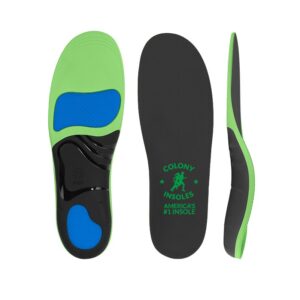 Doctor-Designed Orthotic
Premium Colony Ortho RX
- Recommended by podiatrists
- Memory foam + gel with real arch support
- 60-day money-back guarantee
- Free shipping within the USA
How a hard surface dismantles the foot
Rigid, unyielding flooring reflects ground reaction force straight back up through the heel on every contact, and the stock liner inside most work boots compresses to a flat sheet within weeks of genuine use. Once it bottoms out, nothing stands between concrete and your skeleton, so force climbs the kinetic chain into the arches, the knees, and the lumbar spine. Prolonged standing also exhausts the muscles guarding the arch, letting the rearfoot sag into pronation as the hours wear on. Repeat that daily and an occasional twinge consolidates into pain you cannot leave at the gate.
Built to take the jobsite
The Colony Ortho RX insole is constructed for exactly this loading. A conforming foam top over a gel base absorbs the relentless impact of concrete and steel decking, while a contoured shell supports the medial longitudinal arch and helps govern pronation through every lift, climb, and squat. It is podiatrist-engineered to keep the foot mechanically stable so something is left in the tank when you clock out.
Who fills these boots
Framers, sparkies, roofers, concrete finishers, and general crew, anyone upright from the first horn who needs one orthotic tough enough to outlast brutal conditions while supporting the foot’s architecture.
- Conforming foam and gel absorbing impact from slab and hard subfloors
- Contoured arch support moderating pronation to spare the knees and lower back
- Heavy-duty shock attenuation for ladders, scaffolds, and repeated climbing
- Fits standard work boots and steel-toe footwear
- Free shipping across the USA with a 60-day money-back guarantee
Set them in your boots and the payoff lands where it should: less force punched through the heel, surer footing on broken ground, and an evening when your feet are not collecting on the shift. Crews often read this beside our guidance on insoles for standing all day, and you can match the fit on our work boot shoe inserts guide. If the day leaves your heels especially raw, see insoles for plantar fasciitis.
On site your body is the tool that earns, and your feet bear all of it. Back them with orthotic support sized to the load. Order Colony Ortho RX and notice it on tomorrow’s shift.
Related Insoles & Guides
Frequently Asked Questions
Will these work inside steel-toe boots?
Yes. Pull out the factory liner — likely flattened anyway — and trim the insole to match the boot’s footbed. Steel-toe boots actually pair well with a structured orthotic: the boot supplies the protection, and the contoured shell supplies the arch and rearfoot support the stock liner never had.
My pain is in my knees and lower back — can something under my feet make a difference?
It can, because that pain often starts at ground level. Concrete reflects ground reaction force straight back through the heel, and once a boot’s liner bottoms out, nothing attenuates it — so the load climbs the kinetic chain into the knees and lumbar spine. Absorbing shock at the foot, where it enters the body, reduces what every joint above has to manage.
How do these hold up when boot liners flatten within weeks?
A stock liner is a thin die-cut sheet of foam with no structure, which is why it pancakes under real use. Colony Ortho RX puts a contoured shell at its core, with gel handling the impact duty foam alone can’t sustain. It’s built for jobsite loading, and a 60-day money-back guarantee backs that — work it on concrete and judge for yourself.
What is a twelve-hour shift on concrete actually doing to my feet?
Two things at once. Each step on an unyielding surface sends unabsorbed ground reaction force straight up through the calcaneus — that’s the deep heel ache. Meanwhile, prolonged standing exhausts the muscles guarding the arch, so the rearfoot gradually sags into pronation and the forefoot takes load it shouldn’t, producing the burn. Support and shock absorption address each mechanism.