Understanding the Tarsometatarsal Complex
A Lisfranc injury strikes the junction where the long metatarsal bones anchor into the midfoot, a tightly bound network of bones and ligaments known as the tarsometatarsal complex. The severity runs a broad spectrum, from a stretched ligament to a displaced fracture, and the recovery timeline can be long. Even after the acute injury settles, that region of the foot often stays sore, mechanically fragile, and reactive to pressure for many months. A direct disclaimer first: I’m not a physician, and nothing here is a diagnosis. What I can speak to is how the surface beneath a healing foot reshapes the way weight travels across it.
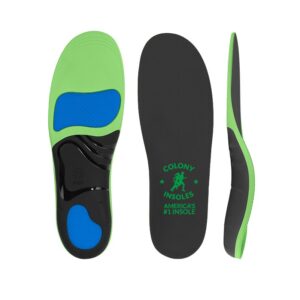 Doctor-Designed Orthotic
Premium Colony Ortho RX
- Recommended by podiatrists
- Memory foam + gel with real arch support
- 60-day money-back guarantee
- Free shipping within the USA
Why Even Load Distribution Protects the Midfoot
Your midfoot acts as the central hinge that the whole body passes load through during midstance. As you rebuild activity after a Lisfranc injury, that area does better when pressure is spread broadly across it, so no single point absorbs a concentrated spike of force. A flat, featureless insole permits the midfoot to sag and bend unevenly, and that irregular flexion through the tarsometatarsal region is precisely what tends to irritate tissue that’s still healing. True arch contact paired with cushioning redirects load away from the vulnerable zone, letting the foot move through stance under gentler conditions.
How Our Orthotic Fits Into Your Plan
Our orthotic seats a geometric arch support below a layered memory foam and gel cushion, the pairing that usually feels gentlest under a tender midfoot. The shell supports the central foot and curbs excess flexion, while the gel dampens impact that would otherwise reach structures still mending. Because this is podiatrist-designed, medical-grade support, it’s meant to sit alongside whatever protocol your own clinician has prescribed, not replace it. Defer to your physician’s instructions first, every time, then let our $29 orthotic make the returning steps steadier.
- A contoured shell that supports and stabilizes the central midfoot
- A gel layer that diverts impact away from healing structures
- Memory foam that spreads plantar pressure broadly across the footbed
- Extra stability for walking with more control as activity ramps up
- A footbed sized to fit both everyday and recovery footwear
Who This May Suit
Anyone returning to weight-bearing after a midfoot injury who wants more supported, more controlled steps through the process, and also the person whose midfoot simply feels weak or achy from day to day. Those rebuilding from foot trauma frequently look at high arch support for additional midfoot contact, or read up on how orthotics work before deciding. One firm caution remains: clear any change with your physician during active recovery, since a Lisfranc injury can demand precise medical oversight.
When you’re ready to make every step better supported, we’re here with free U.S. shipping and a 60-day money-back guarantee. Get your pair today and move your recovery forward with greater confidence.
Related Insoles & Guides
- Best Shoe Inserts for All-Day Comfort
- Heel Inserts for Heel Pain Relief
- Gel Insoles for Real Shock Absorption
- Height-Boosting Shoe Inserts
- Orthopedic Shoe Inserts
- Arch Support Shoe Inserts
Frequently Asked Questions
When in Lisfranc recovery does an insole like this make sense?
Generally after the acute phase, once your treating clinician has cleared you for regular footwear and weight-bearing activity. The tarsometatarsal region often stays reactive for months after the injury settles, and that rebuilding period, when you’re walking more but the midfoot is still fragile, is where broad, even load distribution matters most. Follow your provider’s timeline first.
How does arch contact protect a healing tarsometatarsal joint?
Your midfoot acts as the hinge the body loads through during midstance. When an insole makes true contact under the arch, pressure spreads across a wide area instead of spiking at one tender point, and the midfoot flexes less unevenly. That combination offloads the injured junction where the metatarsals anchor, reducing mechanical irritation to healing tissue.
What makes a flat insole risky for a midfoot that is still healing?
A flat, featureless footbed leaves the arch unsupported, so the midfoot sags and bends irregularly through every step. That uneven flexion runs directly through the tarsometatarsal complex, the exact region a Lisfranc injury damaged, and concentrated spikes of force land where ligaments are still consolidating. Contoured support exists to prevent precisely that pattern.
Can these insoles substitute for the brace or post-op shoe my doctor prescribed?
No. An over-the-counter orthotic is not a medical device for acute fracture management, and we are not physicians. Think of it as a supportive surface for the later, return-to-activity stage, one that spreads load away from the sore midfoot during everyday walking. Keep any prescribed immobilization until the clinician managing your recovery says otherwise.