When the Midfoot Never Reaches the Ground
A cavus foot looks sculpted, yet that elevated instep hands your body a real engineering problem. Because the arch sits so far off the footbed, contact pressure collapses onto just two landing zones, the calcaneus at the back and the cluster of metatarsal heads up front, while the entire span between them floats above the shoe with nothing pressing back. In a flexible foot, the arch lowers slightly at heel strike to spread force across a wider surface. A rigid, high-arched foot skips that dampening step, so each stride drives impact into a tiny footprint instead of dissipating it.
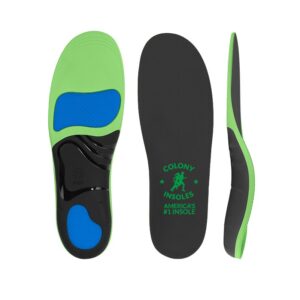 Doctor-Designed Orthotic
Premium Colony Ortho RX
- Recommended by podiatrists
- Memory foam + gel with real arch support
- 60-day money-back guarantee
- Free shipping within the USA
The Biomechanics of a Two-Point Load
Engineers measure this with a pressure map, and a tall instep produces a telling signature: intense readings under the heel and forefoot, almost nothing through the middle. That uneven distribution explains the symptoms cavus feet tend to accumulate, tender metatarsal heads, a heel that aches after hours upright, and a wobble through the ankle on cobblestones or trail because the foot rolls slightly outward toward supination. Correcting it has nothing to do with forcing the arch down. The aim is to occupy the vacant midfoot column so contact area grows and force per square inch drops.
Filling the Vacant Column
Our orthotic is shaped to climb into that empty space and meet the instep along its entire length, turning two pressure points into one continuous bearing surface. A contoured, geometric arch support rises to the height a cavus foot actually needs, while layered memory foam and gel pad the heel and forefoot exactly where the map runs hot. A shock-attenuating base supplies the impact damping a stiff arch cannot generate for itself. The build is podiatrist-developed for standing, walking, and miles on the road.
- Elevated arch geometry tuned to the height of a cavus instep
- Targeted cushioning beneath the two hot zones a pressure map reveals
- Gel damping that substitutes for the shock absorption a rigid arch lacks
- A steadier rearfoot platform to curb the outward roll toward supination
- A single medical-grade pair priced at $29
Is This Your Foot Type?
If shoes always feel hollow under the middle, if footwear shopping is a losing battle, or if you sense every landing rattle up the leg, a cavus profile is likely driving it. High-arched feet frequently carry companion load problems, so it is worth reviewing our shoe inserts for metatarsalgia and our notes on managing heel pain. Treat this as education, not a personal diagnosis.
An arch that high deserves support engineered to reach it. Orders ship free throughout the USA behind a 60-day money-back guarantee, so if your feet are not steadier, return them. Give your cavus arch a full-length foundation.
Related Insoles & Guides
- Shoe Inserts for High Heels
- High Arch Support Inserts
- High Arch Insoles for All-Day Comfort
- Insoles for High Heels
- High Arch Support Insoles for Pain Relief
- Insoles for Low Arches & Flat Feet
Frequently Asked Questions
What does a pressure map reveal about a high-arched foot?
A distinctive two-point signature: intense readings under the calcaneus and the metatarsal heads, with almost nothing registering through the midfoot. That tells you the entire span between heel and forefoot is floating above the footbed, so every step concentrates force into a small footprint instead of dissipating it across the whole sole.
Does this insert try to flatten a cavus arch?
No, and it should not. Correcting a high-arch loading problem has nothing to do with forcing the arch down. The orthotic rises to occupy the vacant midfoot column, so the footbed finally presses back against the instep. Contact area grows, force per square inch drops, and the heel and forefoot stop absorbing everything alone.
Why do my ankles feel wobbly on trails or cobblestones?
A rigid, high-arched foot tends to roll slightly outward toward supination, and on uneven surfaces that lateral bias becomes instability you can feel. Filling the midfoot gap widens the surface your weight actually rests on, giving the foot a broader, steadier platform so the ankle has less room to tip toward its outside edge.
Can spreading contact area really ease heel and ball-of-foot soreness?
That is the core mechanical logic. A flexible arch lowers slightly at heel strike to spread force; a rigid cavus foot skips that dampening step, leaving two small zones to take everything. When a contoured support recruits the midfoot into weight-bearing, peak pressure under the calcaneus and metatarsal heads falls because the same load now covers more surface.