Forefoot hot spots and toe numbness on the bike
An hour into a ride, the ball of the foot starts to burn, or the toes lose sensation and you find yourself flexing them at every light. Riders often accept this as part of clipping in. From a biomechanical standpoint it usually traces to the footbed. Most cycling shoes ship with a thin, flat insert that leaves the medial arch unsupported, so the foot has nothing to push against through each pedal stroke.
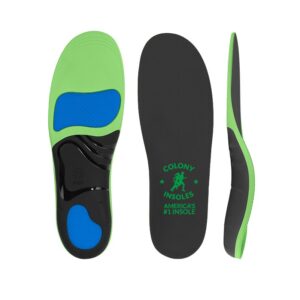 Doctor-Designed Orthotic
Premium Colony Ortho RX
- Recommended by podiatrists
- Memory foam + gel with real arch support
- 60-day money-back guarantee
- Free shipping within the USA
Arch mechanics under repetitive pedal load
Cycling concentrates force through a small contact platform over the cleat. Without arch support, the longitudinal arch deflects slightly on every stroke. The foot lengthens and splays, and load funnels into a few high-pressure points under the metatarsal heads. A firm structural base limits that deflection and redistributes pressure across a broader surface. There is a mechanical efficiency argument too: a foot that resists collapse transmits force to the crank more directly instead of losing energy to soft-tissue flex. Colony Ortho RX builds the arch to hold its geometry under thousands of repeated loading cycles.
How the Colony Ortho RX orthotic is designed
This is a podiatrist-designed, medical-grade orthotic insole. The structured, geometric arch gives the midfoot a stable platform that resists deformation, while a memory foam and gel layer offloads pressure across the forefoot. Built-in shock attenuation dampens the vibration that travels up from rough chip-seal and gravel. The intent is biomechanical control of the foot on the pedal, not generic cushioning.
- Structured arch support for a stable, efficient pedaling platform
- Forefoot pressure redistribution to reduce metatarsal hot spots
- Memory foam and gel cushioning for long, sustained efforts
- Shock attenuation that dampens road and trail vibration
- Midfoot stability that supports better load transfer through the stroke
Who this orthotic is for
Road riders, gravel cyclists, indoor trainers, and bike commuters who notice forefoot burning or toe numbness as mileage builds. When pressure sits directly under the ball of the foot, our metatarsal pad insoles target that region for offloading, and riders replacing a packed-out factory footbed often compare them against our OrthoLite insole alternative.
Your legs should set the limit of a ride, not your feet. Upgrade your cycling shoes for $29 a pair with free USA shipping and a 60-day money-back guarantee, so you can test the support on your longest loop. Order your Colony Ortho RX orthotic insoles and ride with the forefoot pressure under control.
Related Insoles & Guides
- Insoles for Skechers: Add Arch Support
- High Arch Support Insoles for Pain Relief
- Insoles for Pregnancy: Arch & Foot Support
- Insoles for Flat Feet & Arch Support
- Arch Support Shoe Inserts
- Arch Support Shoe Inserts
Frequently Asked Questions
What causes the burning under the ball of my foot an hour into rides?
Pedaling funnels force through a small contact platform over the cleat. On the thin, flat insert most cycling shoes ship with, the longitudinal arch deflects slightly every stroke, the foot lengthens and splays, and load concentrates under the metatarsal heads. Repeated thousands of times, that focused pressure produces the classic hot spot — and often the toe numbness that follows.
Does supporting the arch actually change power delivery to the crank?
There’s a sound mechanical argument. A foot that collapses slightly each stroke loses energy to soft-tissue flex before force reaches the pedal; a firm structural base limits that deflection so the leg drives through a more rigid column. Pressure redistribution is the primary benefit you’ll feel — steadier force transmission is the efficiency bonus riding alongside it.
Can a full orthotic physically fit inside a snug cycling shoe?
Most cycling shoes house a thin removable insert, and this orthotic is trim-to-fit: pull that liner, trace its outline, and cut to match. Because the Colony Ortho RX body carries more material than the stock footbed, expect a slightly snugger feel at first — check closure tension on your first ride and re-tension once the fit settles.
How does the arch stand up to thousands of pedal strokes per ride?
By being structure rather than padding. The arch is built as geometric support engineered to hold its shape under exactly this kind of repetitive compression cycle, where soft foam would gradually pack down and stop pushing back. The midfoot keeps a stable platform to press against on the thousandth stroke as on the first.