The biomechanics behind a collapsed arch
A low or absent arch announces itself through your gait long before you put a name to it: the inside edge of the shoe wears first, the legs feel heavy, and a deep fatigue settles along the inner foot. There is nothing wrong with the shape of your feet, but a structurally flat foot loads differently. The medial longitudinal arch is designed to recoil like a spring, storing and releasing energy at each footfall. When that arch sits low, the foot drops and rotates inward through stance, a pattern called overpronation. The rearfoot everts, the tibia rotates internally to follow, and the resulting misalignment loads the knees, hips, and lower back in ways they were never meant to absorb.
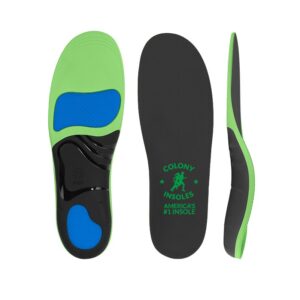 Doctor-Designed Orthotic
Premium Colony Ortho RX
- Recommended by podiatrists
- Memory foam + gel with real arch support
- 60-day money-back guarantee
- Free shipping within the USA
Rebuilding the foundation the arch should provide
Colony Ortho RX is a podiatrist-designed, medical-grade orthotic shaped for precisely this deficit. Its structured arch support fills the void beneath a fallen medial arch, encouraging the rearfoot toward a more neutral posture and easing tensile strain on the plantar fascia as the foot rolls through. Layered above is memory foam over a gel base that molds to your contours, so the correction feels like a contoured cradle rather than an unforgiving plastic ledge. Built-in shock attenuation softens each heel strike before it can ripple up the chain. Maintained across a full day, that steadier alignment is what keeps the inner foot from caving and the legs from carrying the cost.
Who benefits from dedicated arch support
Anyone with congenital flat feet or arches that have gradually descended with age, pregnancy, or years on hard floors. People who have been limping along on flimsy drop-in pads tend to notice the change the first time they stand a while and feel the inward roll ease off.
- Contoured arch support that fills and braces a low or collapsed medial arch
- Pronation control that limits inward roll and helps realign the rearfoot and lower limb
- Plantar fascia relief that reduces the stretch placed on the band with every step
- Memory foam and gel cushioning that adapts to your individual foot
- Free U.S. shipping and a 60-day money-back guarantee
One foundation across every demand
Structural support like this transfers to the clock and the court alike. If your job keeps you upright for hours, our take on insoles for standing all day is worth your time, and if your routine runs explosive and high-load, see our basketball insoles overview. Heavy, aching arches are not a life sentence, though this is educational material rather than a diagnosis, and pain that persists belongs in front of a clinician. Proper support reshapes how each step lands, and with 60 days to judge for yourself, the upside is hard to ignore. Order a pair of Colony Ortho RX and finally give your flat feet a true base.
Related Insoles & Guides
- Insoles for Low Arches & Flat Feet
- Insoles for Pregnancy: Arch & Foot Support
- Insoles for Skechers: Add Arch Support
- High Arch Support Insoles for Pain Relief
- Cycling Shoe Insoles & Arch Support
- Insoles for Wide Feet: Full-Width Support
Frequently Asked Questions
Does an orthotic actually address overpronation, or just pad it?
It addresses the mechanics while you wear it. The structured arch fills the void beneath a fallen medial arch, encouraging the rearfoot toward a more neutral posture so the foot rolls through stance with less inward drop. That also eases tensile strain on the plantar fascia. It is support and realignment, not a permanent reshaping of the foot.
How firm is the arch — will it jab a foot that's used to sitting flat?
The correction is delivered through layered cushioning: memory foam over a gel base molds to your contours, so the arch reads as a contoured cradle rather than an unforgiving plastic ledge. Feet accustomed to zero support often need a short ramp-up in daily wear time as the arch begins carrying load it has been dumping inward.
Why do my shoes always wear down along the inside edge first?
That wear pattern is overpronation written into the sole. When the medial longitudinal arch sits low, the foot drops and rotates inward through stance, the rearfoot everts, and load concentrates along the medial border with every step. Supporting the arch and steering the rearfoot toward neutral shifts that loading back toward the foot’s intended path.
Can flat feet really be behind my knee and lower-back soreness?
They can contribute. When the rearfoot everts, the tibia rotates internally to follow, and that misalignment loads the knees, hips, and lower back in ways those joints were not built to absorb. Restoring support under the medial arch addresses the chain at its origin, though joint pain that persists despite better support is worth discussing with your doctor.