When the Forefoot Starts to Burn
That hot, tender ache parked behind the toes, the spot that can feel bruised by evening, has a clinical name: metatarsalgia. Most people describe it the same way, like a marble underfoot or a bunched sock they can’t smooth out. It’s a loading problem at its core, which is why a mechanical change can shift it quickly. Address where the weight lands, and the forefoot often gets meaningful relief.
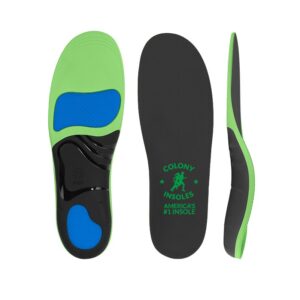 Doctor-Designed Orthotic
Premium Colony Ortho RX
- Recommended by podiatrists
- Memory foam + gel with real arch support
- 60-day money-back guarantee
- Free shipping within the USA
Why the Forefoot Overloads
The ball of the foot rides on the metatarsal heads, a row of small bones that take a large share of body weight at push-off. When the natural plantar fat pad thins, or a collapsing arch shifts load forward, those bones and the nerves running between them get irritated. Flat, rigid insoles do nothing to spread that load and can press it harder onto a small zone. The mechanical fix is twofold: cushion and offload directly under the metatarsal heads, and restore arch height so weight redistributes across the whole foot rather than piling onto one strip.
How the Colony Orthotic Offloads the Forefoot
We layered soft memory foam over a gel base exactly where the ball of the foot lands, and set a structured, geometric arch shell to stop the foot dumping load onto the front. The result is real shock attenuation on every stride, so standing, walking, and running come with far less forefoot burn. Podiatrist-designed, one medical-grade pair for $29, engineered for this specific loading pattern.
- Forefoot cushioning that offloads pressure from the metatarsal heads
- Geometric arch support that pulls load off the front of the foot
- Gel layer that attenuates repeated ground-reaction impact
- Memory foam that settles into the contours of your foot
- Podiatrist-designed support that fits trainers, work shoes, and dress shoes
Who Feels This Most
Runners, retail and restaurant crews who never sit down, and anyone logging hours on hard floors in shoes that have gone flat inside. If the ache ever drifts back toward the heel, our inserts for heel spurs cover that mechanism, and our arch support inserts explain how a supported arch protects the whole foot.
Put the load back where it belongs. Order today with free shipping across the USA and a risk-free 60-day money-back guarantee. Try a pair of Colony Ortho RX. Persistent forefoot pain warrants a clinician’s assessment, so treat this as education rather than personal medical advice.
Related Insoles & Guides
- Insoles for Ball of Foot Pain
- Insoles for Ball of Foot Pain Relief
- Metatarsal Pad Insoles for Ball-of-Foot Pain
- Shoe Inserts for Foot Pain Relief
- Insoles for Neuropathy Foot Pain
- Shoe Inserts for Foot Pain Relief
Frequently Asked Questions
What causes that marble-under-the-toes feeling this page describes?
That sensation is the classic presentation of metatarsalgia: irritation of the metatarsal heads and the nerves running between them. It usually traces to a loading problem, either the natural plantar fat pad thinning or a collapsing arch shifting body weight forward at push-off, concentrating pressure on a small strip of bone behind the toes.
Why would arch support help when the pain sits up front, not in my arch?
Because forefoot overload is often downstream of the arch. When the medial arch collapses, weight migrates forward and piles onto the metatarsal heads instead of spreading across the whole foot. Restoring arch height redistributes that load rearward, so cushioning under the ball eases the symptom while the arch shell addresses the mechanism feeding it.
How is the Colony insole built where the ball of the foot lands?
Soft memory foam is layered over a gel base exactly where the metatarsal heads strike, so each push-off meets shock attenuation instead of a flat, rigid surface pressing load into one small zone. Behind it, the structured geometric arch shell keeps the foot from dumping weight forward, pairing local offloading with whole-foot redistribution.
When should ball-of-foot pain go to a clinician instead of an insert?
Treat insoles as load management, not diagnosis. If the burning turns sharp and electric, numbness spreads into the toes, swelling appears, or pain persists despite offloading, have a podiatrist evaluate it, since nerve irritation between the metatarsals needs direct assessment. For routine overload soreness, a mechanical change is a sensible first step, and ours carries a 60-day money-back guarantee.