Press a thumb along the inner edge of your shinbone after a run that turned sour, and the soreness traces the lower two-thirds of the tibia. That is the signature of medial tibial stress syndrome, the clinical name for shin splints. It can derail a training block in days and make an ordinary stroll something you flinch through. Here is the part that catches athletes off guard: the symptom lives at the shin, but the mechanical culprit almost always sits at the foot.
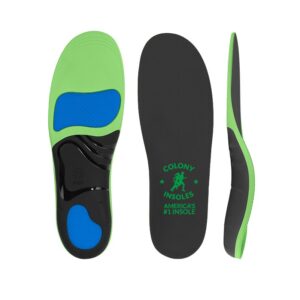 Doctor-Designed Orthotic
Premium Colony Ortho RX
- Recommended by podiatrists
- Memory foam + gel with real arch support
- 60-day money-back guarantee
- Free shipping within the USA
The chain that ends at the tibia
Shin splints emerge where repeated impact collides with weak shock absorption and insufficient arch support. When the foot cannot cushion each landing or hold a stable rearfoot, the soft tissues anchoring along the medial tibia are recruited to compensate, taking on tension they were never designed to bear. Every overpronated step drags on the periosteal attachment at the bone. Layer in hard training surfaces and mounting mileage, and that repeated traction becomes the inflammation registering as pain.
How the orthotic unloads the tibia
The Colony Ortho RX insole addresses the chain at its origin. A gel base attenuates the shock of each footstrike so less force migrates up toward the shin, while the conforming deck spreads pressure across the plantar surface. The contoured shell supports the medial longitudinal arch and helps moderate pronation, encouraging cleaner rearfoot alignment and relieving the traction handed to those overworked lower-leg tissues in the first place.
Built for repetitive load
Runners, walkers, court and field athletes, and anyone whose active habit has triggered shin pain stand to benefit, as do workers on hard floors all day. The insole seats in running shoes, sneakers, and trainers, and trims along the molded guide for a snug fit. Note that pain which is sharply pinpoint or worsening deserves a clinician’s evaluation to exclude a tibial stress fracture.
- Gel shock attenuation that softens repeated footstrike impact
- Conforming deck that distributes plantar pressure broadly
- Contoured arch support that moderates pronation and improves alignment
- Podiatrist-engineered for active, repetitive-load demands
- Trims cleanly for a precise fit in athletic shoes
If mileage is what set the shins off, our insoles for running are tuned for high-impact training, and you can scan the wider lineup of athletic shoe inserts. Underpronators should also read insoles for supination, since poor impact absorption feeds the same problem.
Treat the mechanics beneath the symptom. Order Colony Ortho RX orthotic insoles and give those tibial tissues the support they are calling for.
Related Insoles & Guides
- Shoe Inserts for Shin Splints
- Insoles for Sciatica: Support & Relief
- Insoles for Morton's Neuroma Relief
- Insoles for Bunions: Cushioned Relief
- Shoe Inserts for Foot Pain Relief
- Plantar Fasciitis Explained: Causes & Relief
Frequently Asked Questions
If shin splints hurt at the tibia, why does treatment focus on the foot?
Because the foot is where the load goes wrong. Medial tibial stress syndrome develops when landings arrive with too little shock absorption and the rearfoot lacks stable support, forcing tissues along the inner shin to compensate with tension they weren’t built for. Correcting cushioning and alignment at ground level reduces the stress that ends up registering two segments higher.
Does overpronation pull on the shinbone itself?
Mechanically, yes. Each overpronated step drags on the soft-tissue attachments along the medial tibia, applying repeated traction at the periosteal lining of the bone. Multiply that by the strides in a training week on hard surfaces, and the traction becomes the inflammation you feel along the lower two-thirds of the shin. Supporting the arch limits that pronation-driven drag.
Can I keep training while my shins recover?
That’s a load-management question as much as an insole question. The orthotic reduces two known aggravators — footstrike shock, through the gel base, and pronation-driven traction, through the arch shell — but inflamed tissue still needs its workload lowered. Pairing improved mechanics with a temporary reduction in mileage and softer training surfaces gives the shin room to settle.
When does shin pain warrant more than insoles and rest?
Diffuse soreness along the inner shin that eases as load drops fits the usual pattern of medial tibial stress syndrome. Pain that becomes sharply localized to one spot, persists at rest, or worsens despite lighter training deserves a clinical evaluation to rule out something beyond soft-tissue irritation. This page is education, not a substitute for an exam.