No two feet are alike — so why are most insoles?
Across countless fittings, a matched pair of feet has never turned up, not even the right and left belonging to one person. Yet the typical insert is pressed out flat and quietly expects your foot to bend to it. Mechanically that relationship is inverted, and the foot keeps score. When a footbed cannot answer to your particular arch length, your heel shape, and the pressure landmarks that are yours alone, you collect hot spots, pinch points, and a nagging all-day sense that something below is off. Colony Ortho RX flips the arrangement so the orthotic yields to the foot.
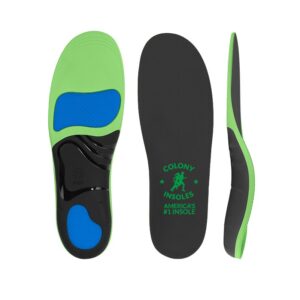 Doctor-Designed Orthotic
Premium Colony Ortho RX
- Recommended by podiatrists
- Memory foam + gel with real arch support
- 60-day money-back guarantee
- Free shipping within the USA
What a conforming footbed accomplishes mechanically
Support a foot along its true contours and plantar pressure disperses over a wider footprint rather than piling onto isolated spots. The result: fewer focal hot zones, less end-of-day fatigue, and cleaner alignment up the leg. A conforming footbed occupies whatever voids a flat slab leaves behind — chiefly the hollow under the inner arch — so the foot quits fighting to hold itself steady. That broader contact is what turns merely-tolerable shoes into ones you reach for.
How ours takes your shape
We built the design around a pliant memory foam upper deck that takes on the form of your foot as the miles add up, cradling the contours unique to you. A gel foundation underneath dampens impact stride after stride, and a structured geometric arch sits lowest to lock the molded contour so it never flattens out. The payoff is a near-bespoke feel that skips the custom-orthotic price tag. The device carries a podiatrist-designed build, and it is the single model we offer — the very one we would drop into our own shoes.
- A memory foam deck that records your individual foot contours over time
- A gel foundation that dampens impact while you stand and walk
- Structured arch support that preserves the molded fit underfoot
- Pressure fanned evenly across the sole with fewer concentrated points
- A near-bespoke feel priced at $29 a pair
Who should look into this
If mass-stamped inserts always seem shaped for somebody else’s foot, or you have eyed costly custom orthotics and flinched at the figure, this was built with you in mind. People working to balance an uneven gait feel the difference most, so if your weight rolls toward the lateral border in supination, our guide to correcting supination is worth your time. Wondering how a molded contour also snugs up a loose shoe? Our page on insoles that make shoes smaller walks through it.
A conforming contour really only makes sense once you stand on it, and what you are reading here counts as general education, not individual medical advice. Each pair ships FREE across the USA with a 60-day money-back guarantee behind it. Break them in, let them register your contours, then judge however you like. Order your Colony Ortho RX and put an orthotic under your foot that finally fits you.
Related Insoles & Guides
- Insoles for Low Arches & Flat Feet
- Easy Feet Comfort Insoles
- Insoles for Wide Feet: Full-Width Support
- Kids' Insoles for Active Growing Feet
- Insoles for Diabetic Feet
- Insoles for Flat Feet & Arch Support
Frequently Asked Questions
Do these insoles actually take on the shape of my foot?
Yes, through wear rather than heat or casting. The pliant memory foam top layer adapts to your arch length, heel shape, and individual pressure landmarks as you put miles on it, while the structure beneath keeps the contour from flattening into a slab. Left and right adapt independently, which matters because no two feet match.
What changes mechanically when a footbed conforms to the foot?
Contact area. Support that follows your true contours fills the voids a flat insert leaves behind — chiefly the hollow under the medial arch — so plantar pressure disperses across a wider footprint instead of piling onto isolated landmarks. Fewer focal hot zones, less end-of-day fatigue, and cleaner alignment up the leg follow from that broader contact.
When does the molding process finish?
There’s no fixed schedule — the memory foam conforms gradually as bodyweight and warmth work it against your contours, so feet, mileage, and footwear all influence the pace. Practically, the 60-day money-back window gives you room to wear them through that adaptation period and judge the finished fit on your own feet, not on a promise.
Can a single off-the-shelf design really suit feet that are all different?
That’s exactly what conforming construction is for. Instead of pressing every foot onto one fixed shape, the yielding top layer lets each foot — including a mismatched left and right — set its own impression while the underlying arch geometry handles load-sharing. You also trim the outline to your shoe, so the finished fit reflects your foot and footwear rather than a factory average.