The swing is a ground-up event. Force originates at the turf, climbs through the feet and pelvis, and unwinds into the clubhead at impact. Anything that destabilizes the platform underneath you leaks speed and dispersion before the motion ever reaches the ball. Now stack the demands of a round on top of that base: four to five hours afoot, well over ten thousand steps across sloping fairways, and roughly seventy full-effort swings. The back nine is where a tired foundation quietly starts costing strokes.
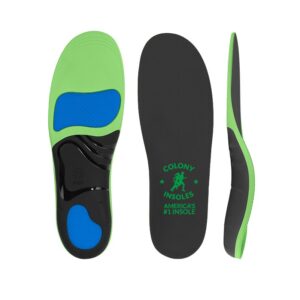 Doctor-Designed Orthotic
Premium Colony Ortho RX
- Recommended by podiatrists
- Memory foam + gel with real arch support
- 60-day money-back guarantee
- Free shipping within the USA
Why the platform sets the ceiling
A repeatable stance requires a foot that stays put through the takeaway, transition, and follow-through. Spend hours traversing soft, uneven ground in spikes lined with a thin factory insert and the arch musculature fatigues, the rearfoot rolls into excess pronation, and your balance point wanders just enough to scatter contact. The kinetic chain can only deliver what the base feeds it, and a drifting base feeds inconsistency.
How the orthotic anchors the swing
The Colony Ortho RX insole carries a contoured shell that supports the medial longitudinal arch and helps govern pronation, holding the foot steady from address through finish, while a conforming foam layer over gel attenuates the impact of all that walking between shots. You get shock absorption that keeps the feet mechanically fresh deep into a full eighteen, plus a stable, repeatable link to the turf when you fully load and release. It is podiatrist-engineered to keep the foot supported through every hole.
Golfers who play on these
Weekend regulars, walking purists who leave the cart behind, and anyone whose feet fold long before their swing does.
- Contoured arch support moderating pronation for a stable, repeatable stance
- Conforming foam and gel absorbing impact over a long walking round
- Shock attenuation that pushes back on late-round foot fatigue
- Fits dedicated golf shoes and spikeless trainers alike
- Free USA shipping with a 60-day money-back guarantee
A quiet platform is not merely comfort, it is contact quality. Keep the foot steady and your base silent and you rotate more freely, hold the finish, and finish stronger when the match tightens. A foot not fighting fatigue also frees your attention for the shot at hand, which adds up over a full card. Walking golfers often read our take on insoles for walking all day, and you can find the right drop-in through our athletic shoe inserts guide.
One orthotic, one fair price, and a steadier base waiting at the first tee. Get Colony Ortho RX and play your next round on footing that holds.
Related Insoles & Guides
Frequently Asked Questions
Does a stable foot really influence the swing itself, or is this just about walking comfort?
Both, and the swing piece is mechanical. Clubhead speed is assembled from the ground up — force starts at the turf and climbs through the feet and pelvis before it ever reaches the club. If the rearfoot rolls or the balance point drifts during the takeaway or transition, that force leaks before delivery. A supported arch keeps the platform fixed from address through finish.
How does the insole hold up across the walking load of a full round?
A round stacks well over ten thousand steps on soft, sloping ground before you count roughly seventy full-effort swings. The conforming foam layer over a gel base absorbs that walking impact so the arch musculature isn’t spent by the turn, while the contoured shell keeps governing pronation as fatigue accumulates — support that’s still working when you reach the back nine.
Can I fit these into spiked golf shoes?
Yes — pull the thin factory insert out first, then trim the Colony Ortho RX to match it. Golf shoes tend to run snug through the midfoot, so the orthotic should replace the stock liner rather than stack on top of it. The contoured shell sits under the arch the same way in a spiked or spikeless shoe.
When during a round does foot fatigue start to affect ball striking?
Usually once the accumulation crosses a threshold — often somewhere on the back nine. Hours of traversing uneven ground tire the muscles that brace the arch; the rearfoot then rolls into excess pronation and the balance point starts wandering at address. Contact scatters not because the swing changed, but because the base feeding it did.