Added height, without sacrificing foot mechanics
Wanting to stand a little taller is reasonable. The problem is how most lift inserts get you there. A wedge of rigid plastic or dense foam raises the heel but ignores everything the foot needs to carry load through a stride. The rearfoot gets shoved upward, the medial arch is left unsupported, and the material stiffens as the day goes on. You end up taller and aching. Colony Ortho RX was designed by a podiatrist-led team to deliver lift as a byproduct of genuine structural support, not at its expense.
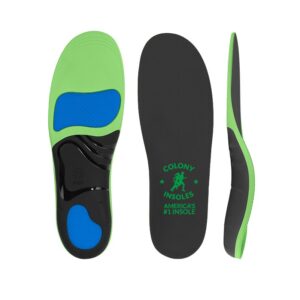 Doctor-Designed Orthotic
Premium Colony Ortho RX
- Recommended by podiatrists
- Memory foam + gel with real arch support
- 60-day money-back guarantee
- Free shipping within the USA
Why most height inserts fail biomechanically
A typical lift insert corrects one variable and disturbs three. It elevates the calcaneus while leaving the arch span hollow, so the plantar fascia and supporting soft tissue absorb load they were never meant to carry alone. It crowds the foot toward the top of the shoe, compromising the toe box. And because it offers no shock attenuation, every heel strike transmits straight into bone. Raise the heel without addressing rearfoot alignment and arch contact, and you have traded a small cosmetic gain for measurable fatigue by mid-afternoon.
How we build lift on a clinical foundation
Our orthotic is engineered for support first, with the added heel height following from that. A layered memory foam and gel system raises the rearfoot meaningfully while attenuating impact at each strike, so the elevation feels supported rather than perched. The structured, geometric arch maintains medial contact and rearfoot alignment, keeping the foot stable through the gait cycle instead of teetering on a raised platform. Shock absorption means added height never reads as a bruised heel. People who switched from rigid lifts describe a steadier, more controlled stance.
- Layered memory foam and gel that elevate the rearfoot while attenuating shock
- Geometric arch support that maintains alignment and lateral stability under the lift
- Impact dispersion so added height never concentrates force on the calcaneus
- Slim, secure profile that preserves toe box room
- Podiatrist-designed, medical-grade support built for all-day wear
Who this suits
If you want a subtle height advantage but aren’t willing to compromise foot function to get it, this is the sounder route. Because it is a true orthotic underneath, it doubles as your everyday comfort and dependable arch support insole, supporting biomechanics rather than just propping you up.
This information is educational and not a substitute for individual medical advice. Stand a little taller on a foundation built for your feet. Every pair ships FREE across the USA with a 60-day money-back guarantee, so you can wear them for weeks before deciding. Order your Colony Ortho RX and feel lift your feet won’t hold against you.
Related Insoles & Guides
- Height-Increasing Insoles
- Height Increase Insoles
- Height Increase Insoles
- Best Shoe Inserts for All-Day Comfort
- Heel Inserts for Heel Pain Relief
- Gel Insoles for Real Shock Absorption
Frequently Asked Questions
How does this insole add height without compromising foot mechanics?
The lift is a byproduct of the structure, not the goal of it. Layered memory foam and genuine arch support raise the foot while the rearfoot stays aligned and the medial arch keeps full contact, so load still travels the way a stride is supposed to distribute it. You stand taller because the foot is properly supported, not despite it.
Why do typical heel-lift wedges leave feet aching by afternoon?
A rigid wedge corrects one variable and disturbs three. It shoves the calcaneus upward while leaving the arch span hollow, so the plantar fascia absorbs load it was never meant to carry alone. It crowds the foot toward the top of the shoe. And with no shock attenuation, every heel strike transmits straight into bone — a trade of cosmetic gain for measurable fatigue.
Will the added thickness crowd my toes the way stacked lift wedges do?
Crowding happens when a steep wedge pushes the whole foot toward the top of the shoe. Because this orthotic builds modest lift from a supportive layered profile rather than a stacked block, it occupies the footbed more like a structured insole than a riser. It’s also trim-to-fit, so you can match it to your shoe’s outline — though roomier footwear always helps.
Does raising the heel change how the arch carries load?
Yes — elevating the calcaneus shifts the foot’s loading pattern, and if the arch span beneath is left hollow, the plantar fascia and supporting soft tissue pick up work alone. That’s the core failure of standard lifts. This design keeps the medial arch supported and the rearfoot aligned through the elevation, so the added height doesn’t come at the arch’s expense.